
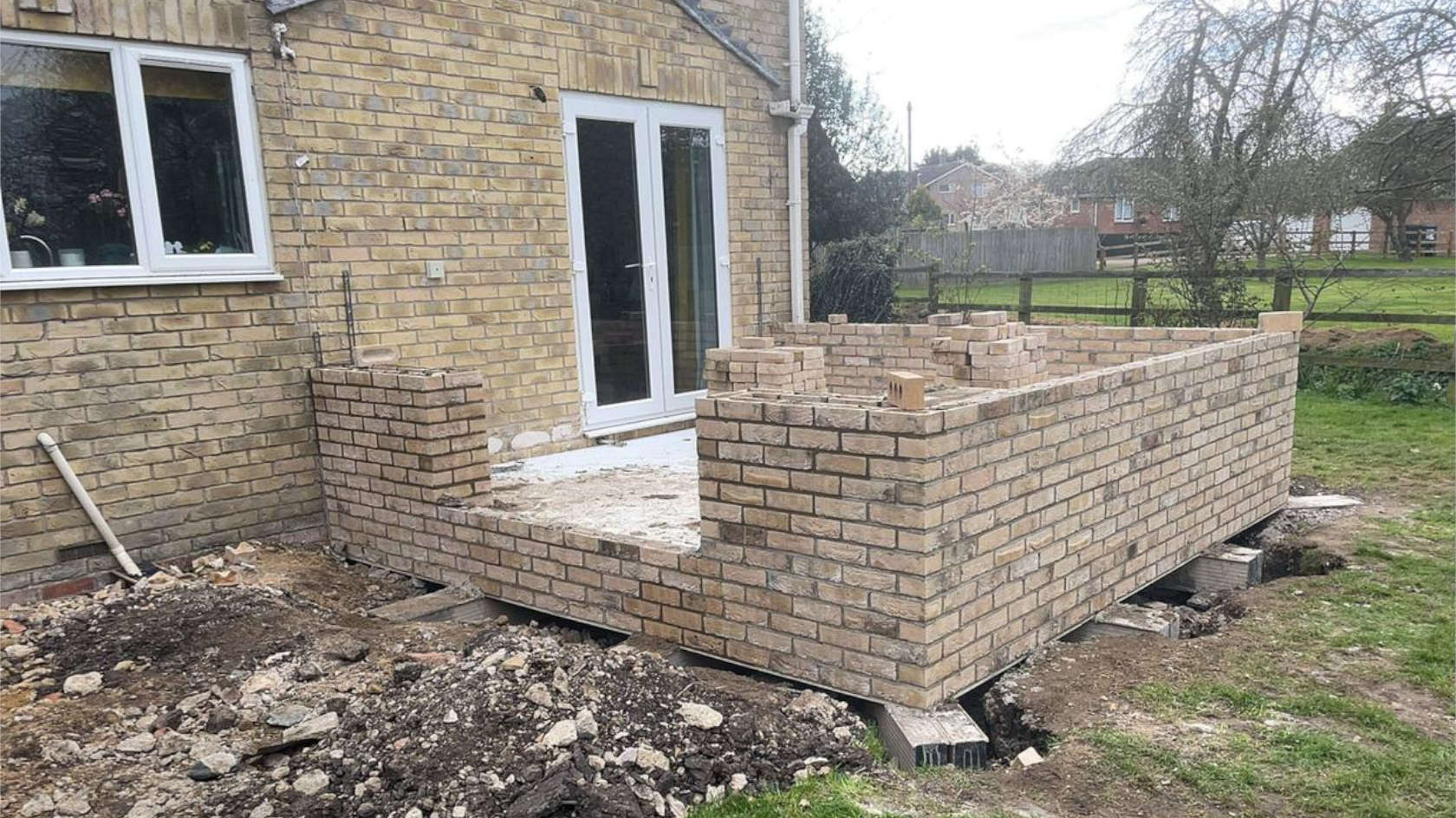
Milton Keynes house prices average £325,000. What an extension realistically adds, what it does not, and where the local ceiling sits.
What an extension adds to a Milton Keynes house price, and what it does not
Extending is one of the most common ways homeowners in Milton Keynes try to get more from a property they already own. It is also one of the easier ways to spend £60,000 and see half of it back. The gap between those two outcomes usually has less to do with build quality than with what the extra space is called when the house next goes on the market. The published data on local prices and on the value of extra floor space is reasonably clear about which extensions pay and which do not.
What an extension adds to a Milton Keynes house price
An extension adds roughly 5% to a home's value for each 10% of floor area gained, according to Nationwide's analysis of its own lending data. Where it creates an additional bedroom and bathroom, that can reach 24%. Against the Milton Keynes average price of £325,000, that is a spread of about £16,000 to £78,000.
Those percentages come from Nationwide's October 2025 research, which set sale prices against property characteristics including floor area, bedroom count, bathroom count, property type and locality. They are national figures rather than Milton Keynes ones, so they describe the shape of the relationship rather than a valuation on any particular house. Local price data fills in the rest.
The local ceiling matters more than the build
Average prices across the city hide a wide spread by property type. Office for National Statistics and HM Land Registry figures put the June 2026 averages at £551,000 for a detached house, £329,000 for a semi, £271,000 for a terrace and £166,000 for a flat or maisonette. The overall average of £325,000 was flat on the year, with semis up 1.1% and flats down 1.9%.
Read those together and a useful point falls out. The gap between the average terrace and the average semi is around £58,000. The gap between a semi and a detached house is more than £220,000. No extension moves a property between those categories. A terraced house with a large rear extension is a large terraced house.
This is what agents mean by a street ceiling. On a road of near-identical three-bedroom semis, and the grid square estates have plenty of those, buyers carry a rough sense of what a house there is worth. An extension can push against that number without breaking through it. The further a property is taken above anything nearby has sold for, the less of the spend comes back.
Bedrooms move the price further than floor space
Nationwide's figures separate the effect of extra floor area from the effect of what that area is used for, and the difference is large.
Going from two bedrooms to three added 13% to a terraced house, 14% to a semi and 17% to a detached home. Going from three to four added 10% to a terrace, 10% to a semi and 13% to a detached. Floor space on its own added around half as much. The research assumed roughly 13 square metres for an additional bedroom, and 28 square metres for the bedroom and bathroom combination that reached 24%.
The practical reading is that an extension which changes how a house is described does more than one which makes existing rooms larger. A knocked-through kitchen diner improves daily life and photographs well. It does not turn a three-bed into a four-bed, and the filters buyers search with are built around bedroom counts.
Heritage Build Group, a home extension specialist working across Northamptonshire and neighbouring counties, sees the same split at quoting stage. "The question we get asked most is how far back we can go," the company said. "The better question is what the space will be called when the house is sold. Twenty square metres of bigger kitchen and twenty square metres that creates a proper fourth bedroom cost about the same to build. They do very different things to a valuation."
What decides whether the money comes back
Whether an extension pays for itself tends to come down to a short list:
- Whether it adds a bedroom, rather than only adding square metres
- Whether the finished house stays under the ceiling price for that street and property type
- How much garden is left, since outdoor space carries weight in family areas
- Whether an existing room is lost or made unusable, such as a bedroom given up to a stairwell
- Whether the layout still works, particularly natural light to rooms left landlocked behind the new build
- Whether the work is signed off properly, because missing building control paperwork surfaces during conveyancing and gets priced in
Nationwide found only 4% of homeowners who had renovated regretted it. Among those who did, cost overruns and a finished result that did not match expectations were the most common reasons, cited by 41%.
Planning rules are not the same across the city
Milton Keynes contains two quite different housing stocks, and the rules land differently on each.
The grid square estates built from the late 1960s onwards generally hold full permitted development rights. Under those, a single-storey rear extension can go up to three metres beyond the original rear wall on a terraced or semi-detached house, or four metres on a detached one, subject to a four metre height limit and a lower eaves limit within two metres of a boundary. The larger home extension route, which requires prior approval and a neighbour consultation, doubles those depths to six and eight metres. No more than half the land around the original house can be built on.
The older towns absorbed into the new city sit differently. Stony Stratford, Newport Pagnell, Olney, Wolverton and Woburn Sands all contain conservation areas, where permitted development rights are reduced and the larger extension route does not apply. Flats and maisonettes have no permitted development rights for extensions anywhere.
One clause catches people out across the whole city. Allowances are measured against the original house, meaning the property as first built, or as it stood in July 1948 for older stock. Plenty of 1970s and 1980s Milton Keynes homes were extended once already, and what remains is the leftover allowance rather than a fresh three or four metres.
Weighing the spend against the uplift
Nationwide put average renovation spending at around £52,000 across everyone who had improved a home in the previous five years. That covers everything from a new bathroom to a two-storey extension, so it is a poor guide to any single project, but it shows the order of magnitude homeowners are committing to.
Set that against the local numbers. A 24% uplift on the Milton Keynes average of £325,000 is roughly £78,000, but that figure is the best case: a three-bedroom, one-bathroom house gaining a large double bedroom and a bathroom. A 10% increase in floor space on the same house is closer to £16,000. Most projects land somewhere between the two, and some land below what they cost.
Garage conversions are worth a mention, because integral garages are common in grid square housing. Converting one is a cheaper route to floor area than building new, though it only counts toward value if the result reads as a proper room rather than a converted garage, and if losing covered parking does not matter on that street.
Space is worth more when it changes what the house is
Milton Keynes prices have been flat for a year, and a flat market is less forgiving of an extension that overshoots its street. That does not make extending a poor decision. It makes the brief matter more than the budget.
The extensions returning the most are the ones that change how a property is described: a two-bed that becomes a three-bed, or a three-bed with one bathroom that gains a fourth bedroom and an ensuite. The ones returning the least make a house bigger without making it different, or push a terrace past anything a terrace on that road has sold for.