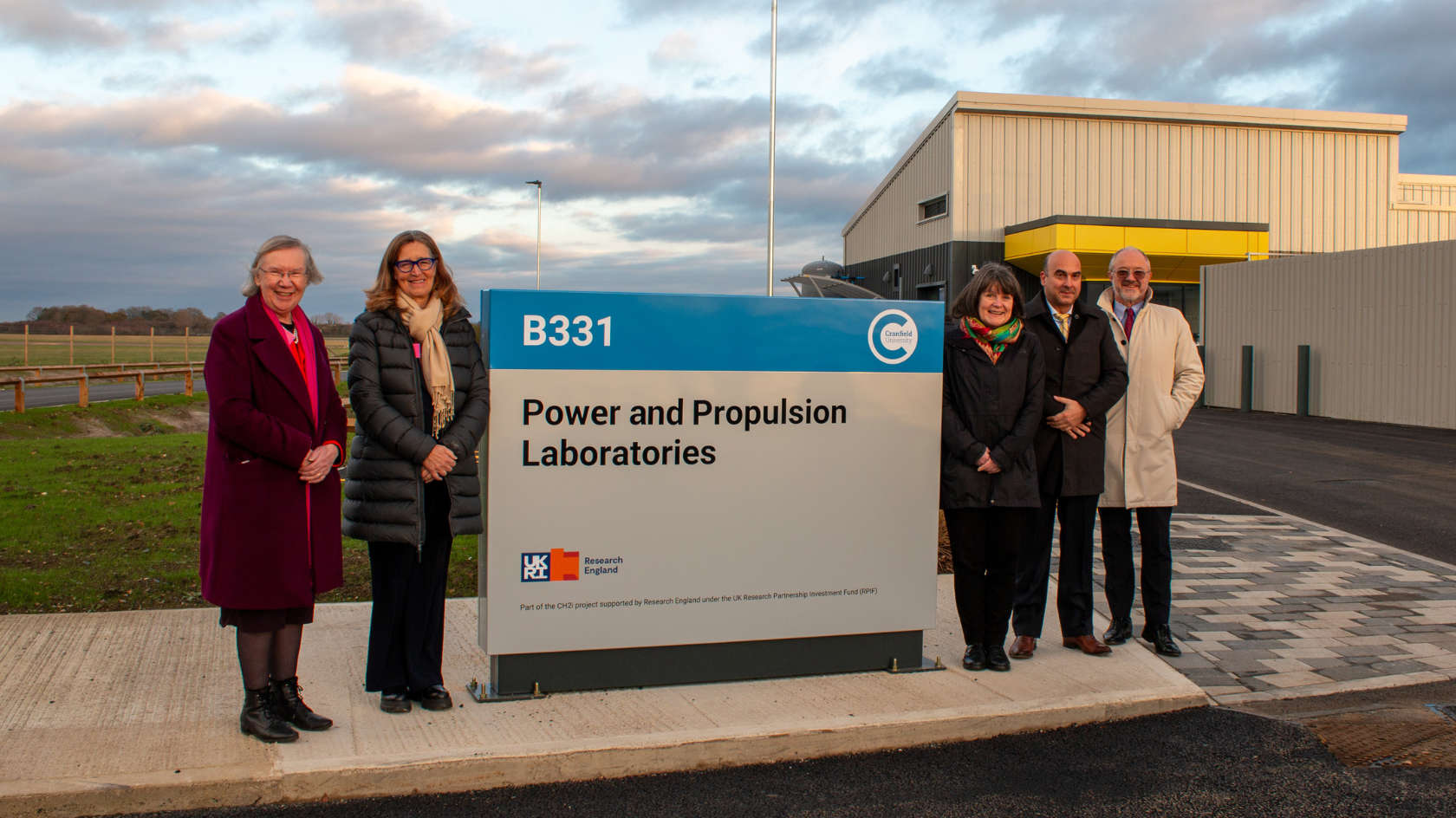
A new test cell facility at Cranfield University’s campus, developed as part of the Cranfield Hydrogen Integration Incubator (CH2i) project, was officially opened last week.
The new Cranfield Power and Propulsion Laboratories (CPPL) give academia and industry a collaborative space for advanced research into new technologies for decarbonisation.
Built right next to the airport airside boundary, at the centre of the Cranfield campus, the new lab spaces will also be used to train new talent needed by industry, including master’s and PhD students at Cranfield.
Vice-Chancellor Professor Dame Karen Holford DBE FREng welcomed the new development: “It’s facilities like these which enable us at Cranfield to work so effectively with our industry partners," she said, "That collaboration is in our DNA and it’s something we are very proud of. The new labs extend our research capacities even further, enabling us to make more positive advances towards green energy.”
Professor Vassilios Pachidis, Head of Centre for Propulsion and Thermal Power Engineering, oversees the new facility.
“The new Cranfield Power and Propulsion Laboratories (CPPL) will help shape the future of flight," he said, "By solving the challenges around the aerodynamic and thermodynamic integration of advanced power and propulsion systems into aircraft, we will make aviation cleaner and more efficient.
“The new labs will help accelerate the use of Sustainable Aviation Fuels (SAF) and H2, explore systems for electrification and hybridisation, as well as the potential benefits of supercritical CO2 and other ‘unusual’ working fluids for thermal management applications.
“This is another great step forward for the UK’s drive towards sustainable aviation.”